
Last updated September 17, 2026.
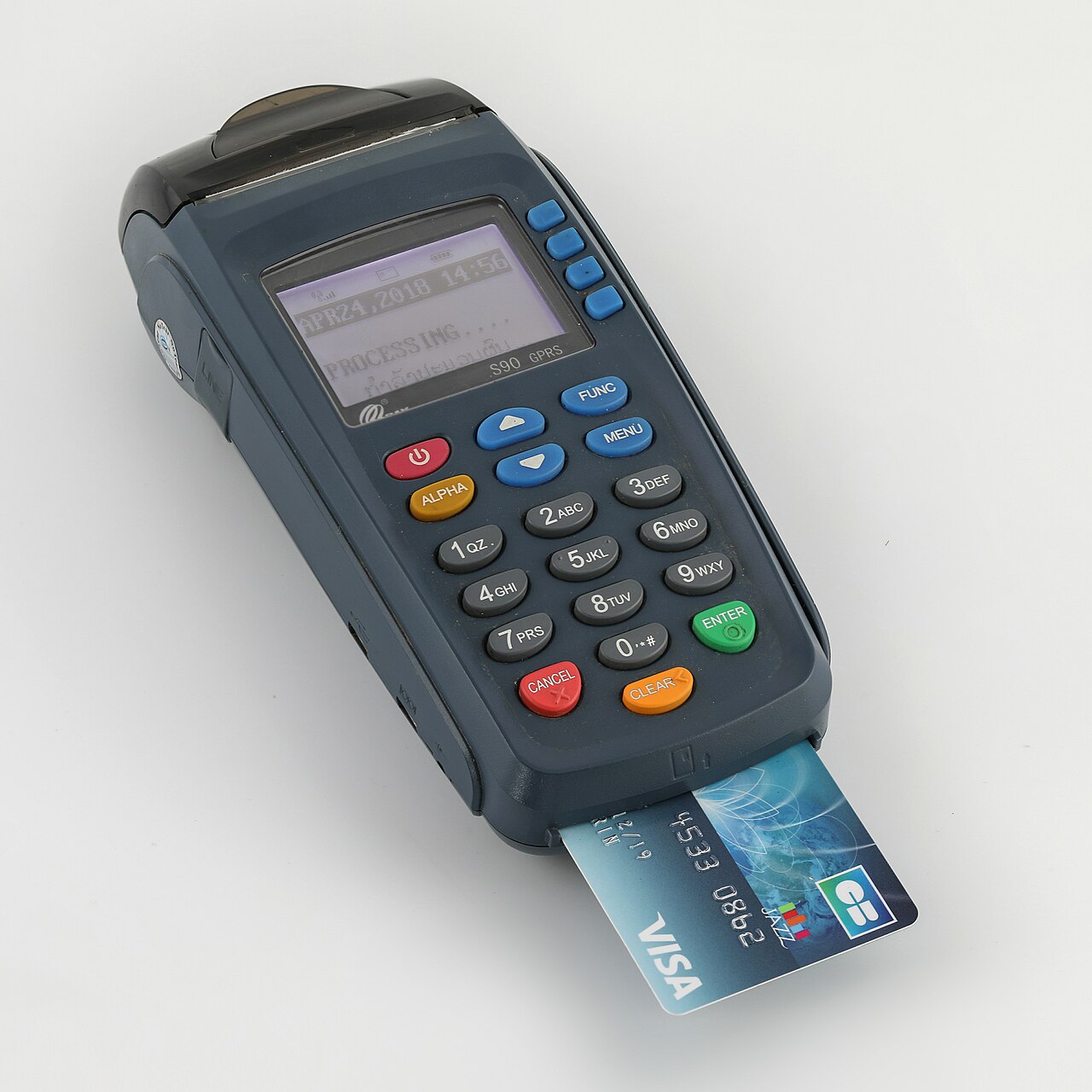
You tap your card, the terminal beeps, and you walk away with your coffee. In those couple of seconds, messages have crossed several companies' systems to answer one question: should this purchase be approved? But the money itself hasn't moved yet. Here's the full journey, who touches it, and who gets paid along the way.
Key takeaways
- A card payment happens in three stages: authorization (approve it), clearing (confirm the details), and settlement (actually move the money) [1].
- At least four parties are involved: you, your card issuer, the merchant's acquirer, and the card network connecting them.
- Cards remain the most-used U.S. payment method by count: more than three-quarters of 236.6 billion noncash payments in 2024 [2].
- Merchants pay for acceptance through fees that include interchange; those fees are the subject of a major 2026 settlement and ongoing litigation over debit caps [3][4].
The cast of characters
| Role | Who they are | What they do |
|---|---|---|
| Cardholder | You | Presents the card, phone, or card number |
| Merchant | The store or website | Accepts the payment |
| Issuer | The bank or credit union that gave you the card | Approves or declines; bills or debits you |
| Acquirer (merchant bank) | The bank that signs up the merchant | Receives funds on the merchant's behalf |
| Processor / gateway | Technology firms working for acquirers and merchants | Carry the messages and connect terminals and websites |
| Card network | Visa, Mastercard, American Express, Discover | Sets rules and routes messages between issuers and acquirers |
Mastercard describes its network's role as linking issuers, "banks providing cardholders' accounts," and acquirers, "banks processing merchants' transactions" [1]. American Express has historically acted as both network and issuer for many of its cards. Discover has been part of Capital One since May 18, 2025 [5].
Many small merchants don't have a direct acquirer relationship. They sign up with a payment facilitator (a "PayFac" such as an all-in-one checkout provider), which sits under an acquirer and onboards many small sellers at once. Related field note
Stage 1: Authorization (about two seconds)
- You present the card. A chip or contactless tap generates a one-time cryptogram, a code that makes copied data hard to reuse. Online, you type or autofill the card number, and the site may use a stored token instead of your real number.
- The merchant's terminal or checkout sends a request to its processor and acquirer with the amount, merchant details, and card data.
- The acquirer forwards it to the card network, which identifies the issuer from the card number and routes the message.
- The issuer decides. It checks that the card is valid, that funds or credit are available, and runs fraud models. Mastercard summarizes this stage as messages "necessary to verify the identity of the cardholder, authenticity of the card and availability of funds at the time of purchase" [1].
- The approval (or decline) travels back the same path, and the terminal beeps.
What actually happened to your money? For a credit card, the issuer reduced your available credit. For a debit card, your bank typically placed a hold on the amount. Nothing has settled yet.
Why some purchases show a "pending" amount that changes
Restaurants, hotels, and gas stations often authorize an estimated amount and then finalize it later (for example, after a tip). That's why the pending charge you see can differ from the final one.
Stage 2: Clearing (later that day, usually)
At the end of the day, or at intervals, the merchant sends its approved transactions in a batch for final processing. Clearing is the exchange of "financial transaction details between an acquirer and an issuer to facilitate posting to a cardholder's account" [1]. The network calculates what each side owes, including fees.
If a merchant never sends a transaction for clearing, the hold eventually drops off your account.
Stage 3: Settlement (typically within a day or two)
Settlement is when money really moves. The network calculates each participant's net position and the funds are transferred between issuers and acquirers [1]. The acquirer then pays the merchant, minus fees, on whatever schedule their contract sets. Timing varies by provider and contract; some offer faster payouts for an extra fee.
Your issuer, meanwhile, either adds the purchase to your credit card statement or finalizes the debit from your checking account.
Where the fees go
A merchant rarely sees one fee. The total cost of acceptance, often called the merchant discount rate, bundles:
- Interchange: paid from the acquirer's side to the issuer. It is usually the largest piece and varies by card type (debit vs. credit, rewards vs. standard), merchant category, and whether the card was present.
- Network (scheme) fees: paid to Visa, Mastercard, and others.
- Processor/acquirer markup: the provider's own margin and services.
For context on scale, a court filing summary of the Visa and Mastercard merchant settlement cited a 2024 baseline weighted-average fee of 2.35% on those networks' transactions [6]. Related field note Related field note
What changed in 2026
- The Visa/Mastercard settlement. On June 9, 2026, Judge Brian Cogan in the Eastern District of New York granted preliminary approval to a revised settlement of merchants' long-running class action. Reported terms include a 10-basis-point reduction in interchange rates for five years, a 1.25% cap on rates for standard consumer credit cards for eight years, and new flexibility for merchants to decline premium and commercial cards and to surcharge [3][6]. Large merchants objected, final approval is still pending, and appeals are expected [3][6].
- Debit caps in court. For large U.S. debit issuers, the Federal Reserve's Regulation II caps debit interchange at 21 cents plus 0.05% of the transaction, with a possible one-cent fraud-prevention adjustment. In August 2025 a federal court in North Dakota vacated the rule's fee standard but stayed its ruling pending appeal to the Eighth Circuit; a separate Fed proposal to lower the cap is pending [4]. Check current status before relying on these numbers.
Card-not-present: online payments add extra steps
Online, the merchant can't read a chip, so fraud risk is higher and extra tools come in:
- Tokenization: the network replaces your card number with a token tied to a specific merchant or device. If a merchant is breached, the token is less useful to criminals than your real number.
- 3-D Secure: an extra authentication step (a banking-app prompt, a biometric, or a one-time code) that the issuer can trigger for risky transactions. Related field note
- Address and CVV checks: basic data matches that feed the issuer's decision.
When something goes wrong: disputes and chargebacks
A chargeback reverses a card payment through the network's dispute rules. For U.S. credit cards, federal law gives you strong rights: you generally have 60 days from when a charge appears on your statement to send a written billing-error notice, and the issuer must acknowledge it within 30 days [7]. Debit cards are covered by different rules (the Electronic Fund Transfer Act and Regulation E), and timelines matter even more.
For merchants, chargebacks come with fees and the burden of proving the sale was legitimate. This built-in reversibility is a key difference from many account-to-account payments, which are harder to claw back once sent. Related field note Related field note
Why this design has lasted
Cards remain dominant because the system solves problems for everyone at once: shoppers get credit, rewards, and dispute rights; merchants get guaranteed authorization and access to nearly every customer; issuers earn interchange. The Federal Reserve's 2025 triennial study found debit cards still led, but credit card payments grew faster than debit for the first time in nearly a decade [2].
The trade-off is cost, which is why merchants are testing alternatives such as instant bank payments, and why fee litigation keeps returning to court. Related field note
FAQ
How long does a card payment take to process? Authorization typically takes a couple of seconds. Clearing and settlement, where money actually moves between banks, usually follow over the next day or so, depending on the merchant's provider and contract.
What is the difference between an issuer and an acquirer? The issuer is your bank, which gives you the card and approves purchases. The acquirer is the merchant's bank, which receives payment for the merchant.
Who pays interchange fees? Interchange is charged on the merchant's side of the transaction and paid to the issuer. Merchants may build acceptance costs into prices or, where allowed, add surcharges.
Why did my pending charge change amount? Some merchants authorize an estimate (for tips, fuel, or hotel stays) and send the final amount at clearing.
Is tapping a card safer than swiping? Contactless and chip payments use one-time cryptograms, which make stolen data harder to reuse than magnetic-stripe data.
Can I reverse a card payment? You can dispute charges under federal law and network rules. For credit cards, send written notice within 60 days of the statement showing the charge [7].
Sources
- Mastercard, "Mastercard Switching explained," https://www.mastercard.com/eea/switching-services/our-technology/transaction.html, accessed 2026-09-17.
- Federal Reserve Board, "Federal Reserve issues initial findings from its 2025 triennial payments study," https://www.federalreserve.gov/newsevents/pressreleases/other20260701a.htm, July 1, 2026, accessed 2026-09-17.
- American Banker, "Judge approves card network-fee settlement with merchants," https://www.americanbanker.com/payments/news/judge-approves-card-network-fee-settlement-with-merchants, June 10, 2026 (updated June 11, 2026), accessed 2026-09-17.
- Cooley LLP, "District Court Vacates Regulation II's Debit Card Interchange Fee Standard," https://www.cooley.com/news/insight/2025/2025-08-15-district-court-vacates-regulation-iis-debit-card-interchange-fee-standard, Aug. 15, 2025, accessed 2026-09-17.
- Capital One Financial Corp., "Capital One Completes Acquisition of Discover," https://investor.capitalone.com/news-releases/news-release-details/capital-one-completes-acquisition-discover, May 18, 2025, accessed 2026-09-17.
- Payments Dive, "Court approves Visa-Mastercard settlement," https://www.paymentsdive.com/news/court-approves-visa-mastercard-settlement/822440/, June 2026, accessed 2026-09-17.
- Consumer Financial Protection Bureau, "How do I dispute a charge on my credit card bill?," https://www.consumerfinance.gov/ask-cfpb/how-do-i-dispute-a-charge-on-my-credit-card-bill-en-61/, accessed 2026-09-17.
Disclaimer: This article is for educational purposes only and is not financial, legal, or tax advice. Fees, network rules, and legal proceedings change; verify current terms with your card issuer, payment provider, and official sources.